Booking choice: The guided Kjerag day. Check dates Tour details
Most people who hike Kjerag call it the hardest day walk of their trip. Fjord Norway grades it demanding (red) and says you need good fitness; Visit Norway calls it demanding even for experienced hikers. Neither is exaggerating. The distance is modest. The gradient isn't.
Below are the numbers from the official tourist boards, what the three climbs are like, how long people really take, and a simple test you can do at home before you book anything.
The quick answer
Plan on about 11 km round trip, 750 to 800 m of total ascent and about 6 hours from the Øygardstøl car park, more with a queue at the boulder. There are three steep climbs each way, with chains on the steepest slabs. No climbing skill is needed, but you do need good fitness, boots with grip and the nerve to come down chains on bare rock.
Is the Kjerag hike difficult?
Yes. It is graded demanding: about 11 km, roughly 750 to 800 m of climbing and three steep ascents each way over exposed granite.
The car park at Øygardstøl sits at about 640 metres and the boulder at about 1,000 metres. That gap is only 360 metres, but the trail climbs and drops over three ridges, which is why the cumulative ascent doubles it. You do the up-and-down twice, because the way back crosses the same ridges.
| Kjerag hike | Figure | Source |
|---|---|---|
| Round trip | About 11 km | Fjord Norway |
| Total ascent | About 750 to 760 m (Visit Norway: 800 m) | Fjord Norway, Visit Norway |
| Time | About 6 hours; 6 to 10 hours | Fjord Norway; Visit Norway, Fjord Tours |
| Start | Øygardstøl car park, about 640 m | Rødne |
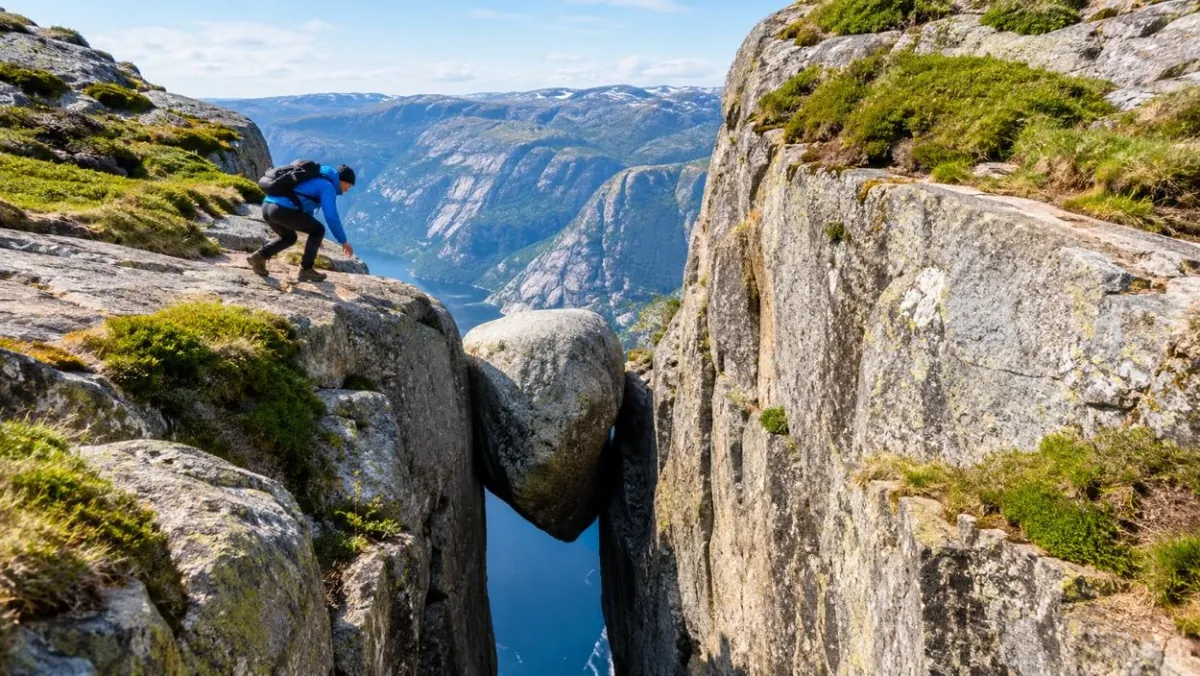
| Boulder | About 1,000 m, 300 m south of the Nesatind cairn | Fjord Norway |
| Grade | Demanding (red) | Fjord Norway |
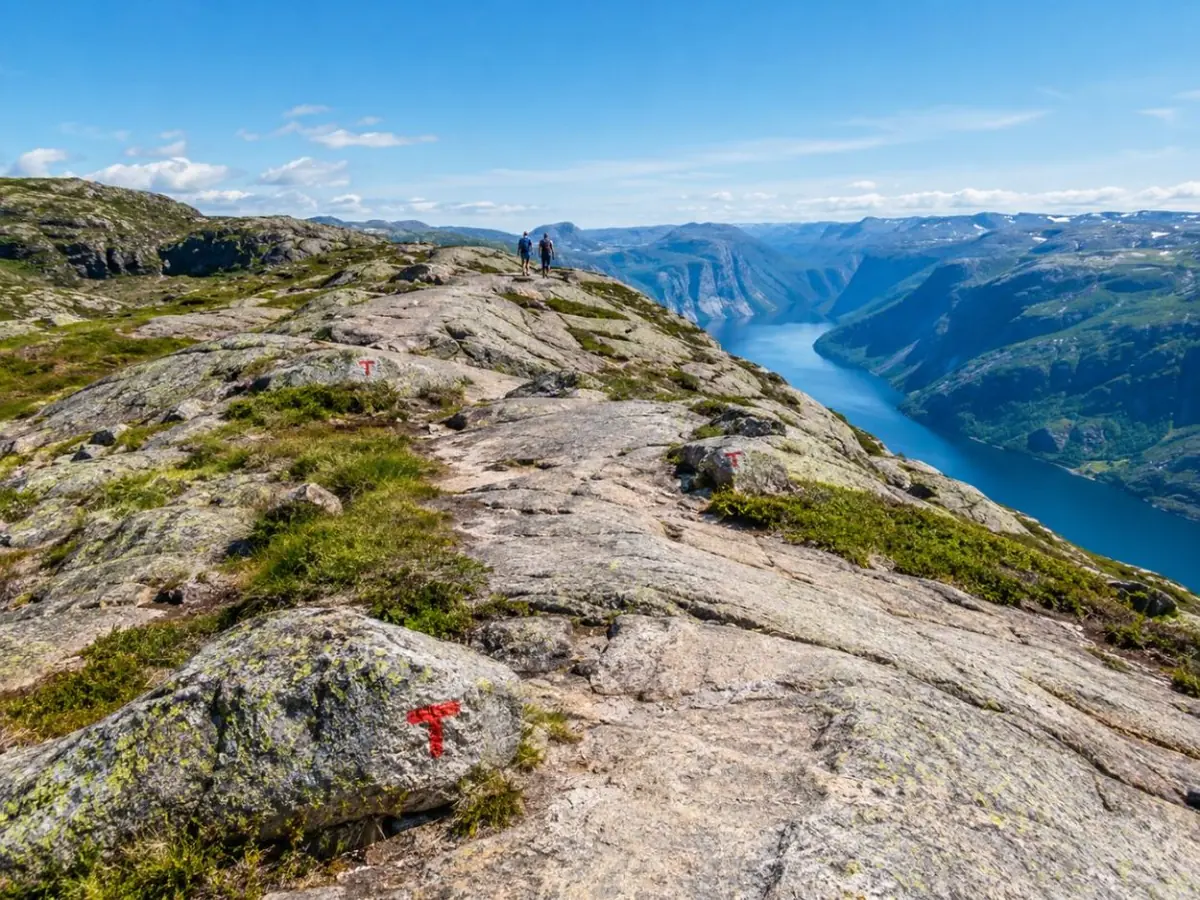
| Waymarking | Red T painted on the rock | DNT standard |
Is it the hardest hike in Norway? No. Trolltunga is far longer and plenty of alpine ridges are harder. Among the Lysefjord classics, it's the steepest by a distance.
What are the three climbs like?
Three steep pitches of bare granite separated by shallow valleys. The first starts almost at the car park and is the steepest; the third lifts you onto the plateau.
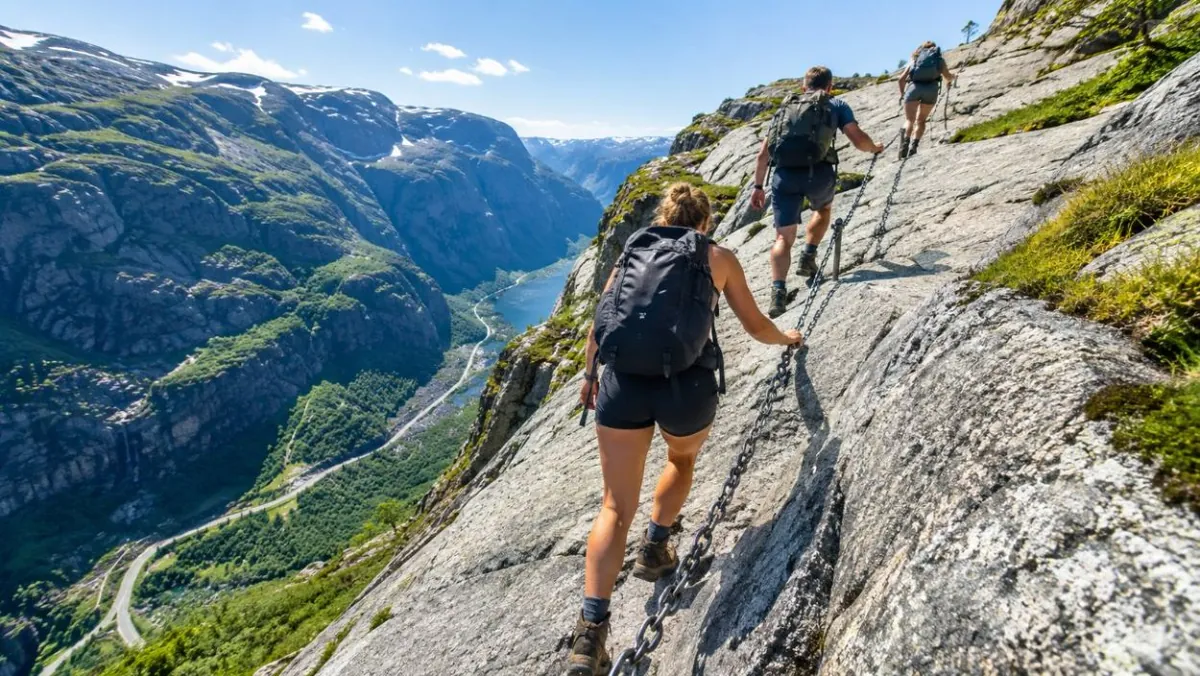
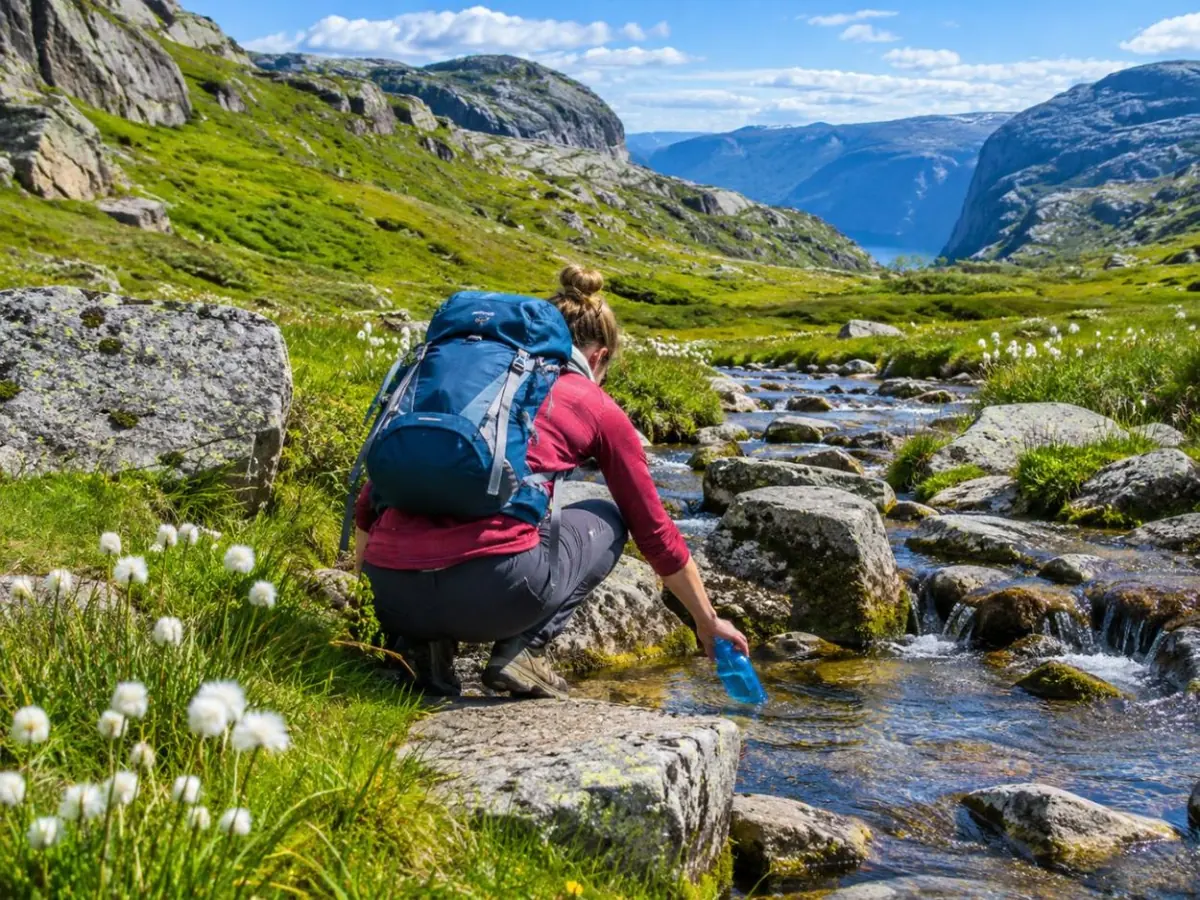
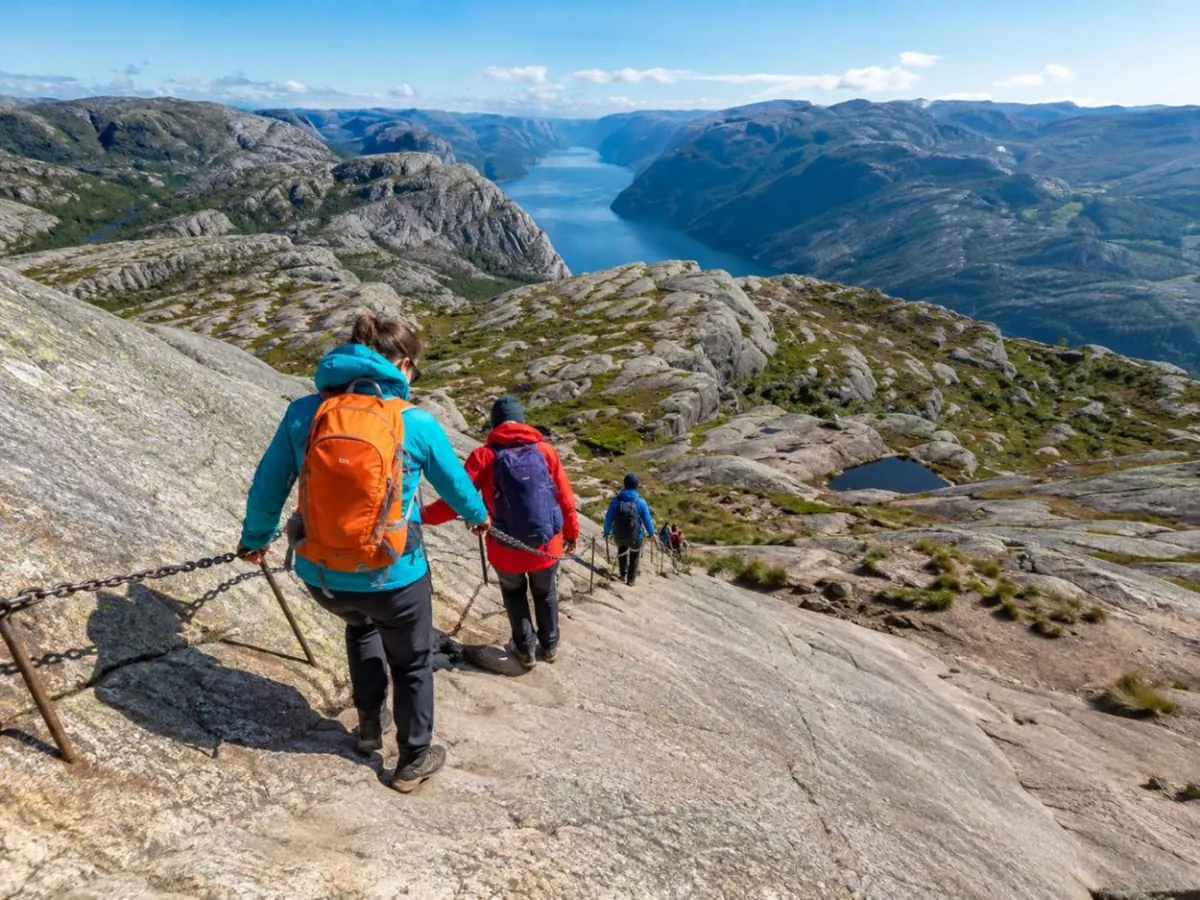
The first climb hits straight away: a long slab with chains that gets the heart rate up before you are properly warm. You drop into a valley, then climb a second ridge, again on rock with chains in the steep parts. A second descent takes you down to Storedalen, a valley with a stream where Fjord Norway says you can refill your bottle. The third climb is the last big push onto the high plateau.
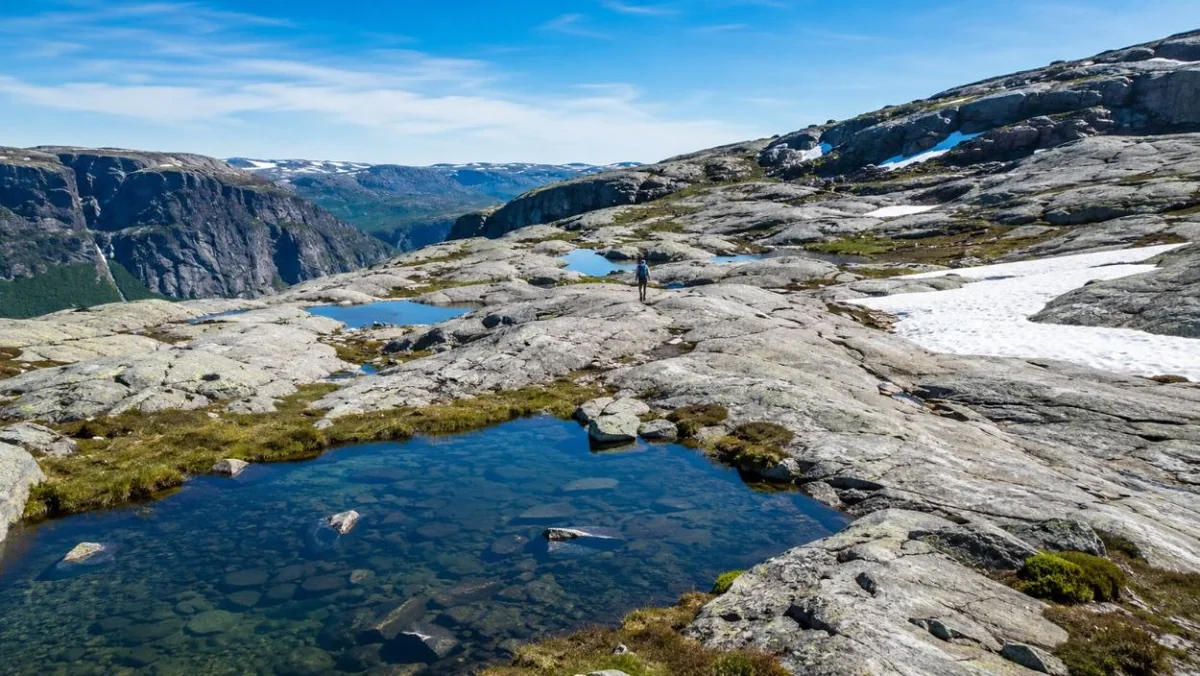
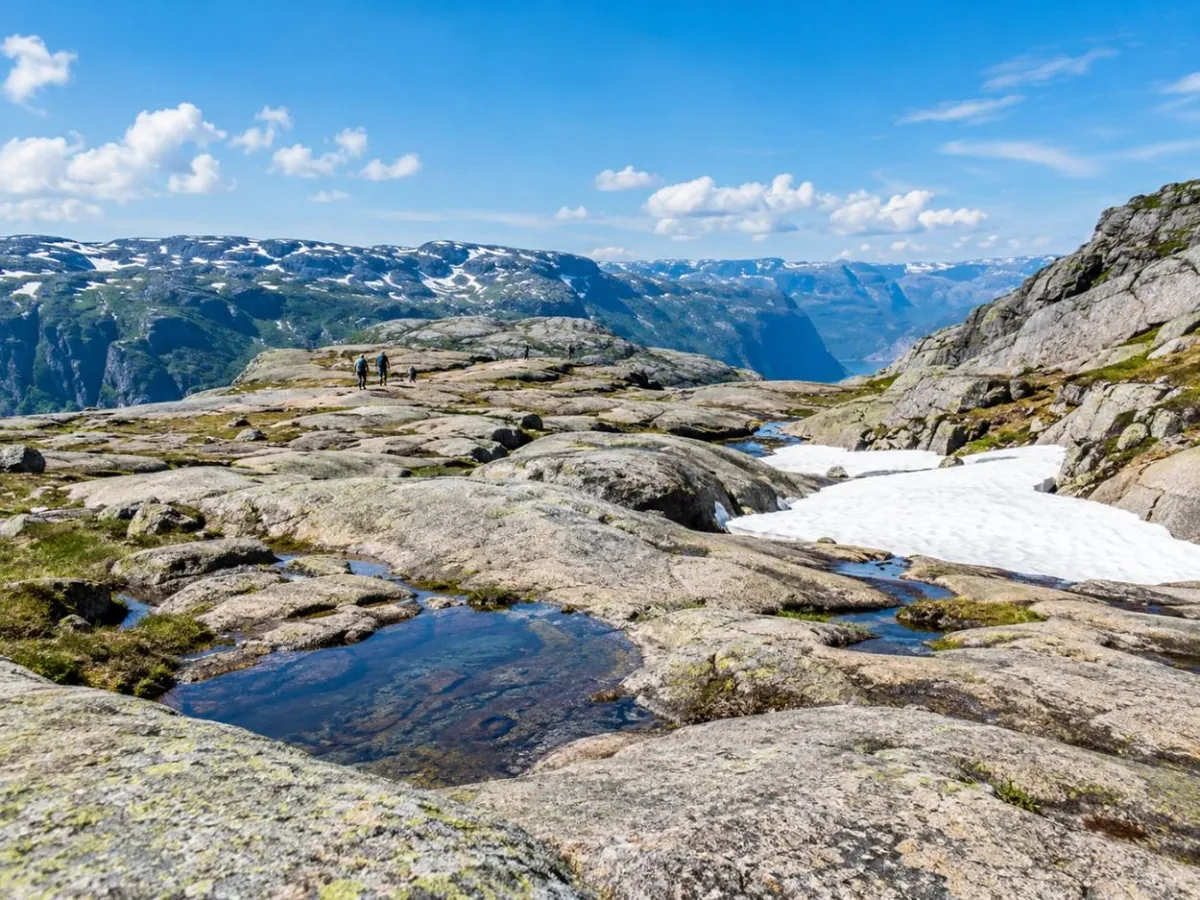
From there it is rolling granite, pools and boulder fields for the last stretch to the crevice. The plateau section feels easy after the climbs, but it is where people lose the markers in fog. The guided listing sums the structure up as "three climbs separated by alpine valleys", and guests keep calling it "challenging".
Let someone else drive and set the pace: up to eight hikers, a guide and the van from Stavanger.
Check dates for the guided Kjerag dayHow long does it take to hike to Kjeragbolten?
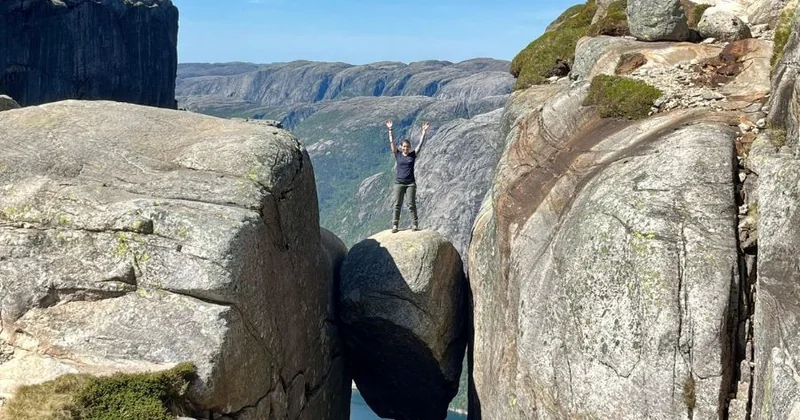
About 3 hours each way for a fit hiker, so about 6 hours round trip. Allow 7 to 8 if you're slow on rock, and add 30 minutes to an hour for the queue at the boulder.
The official range is wide because people differ so much on steep rock. The tours give useful real-world markers:
| Who | Time on the trail |
|---|---|
| Fjord Norway estimate | About 6 hours round trip |
| Visit Norway, Fjord Tours | 6 to 10 hours round trip |
| Guided Kjerag day | About 5.5 hours of guided hiking |
| Private Kjeragbolten hike | Plateau after about 2 to 3 hours; about 6 hours at Kjerag in total |
| Two-day trip | About 5 hours, starting fresh from Lysebotn |
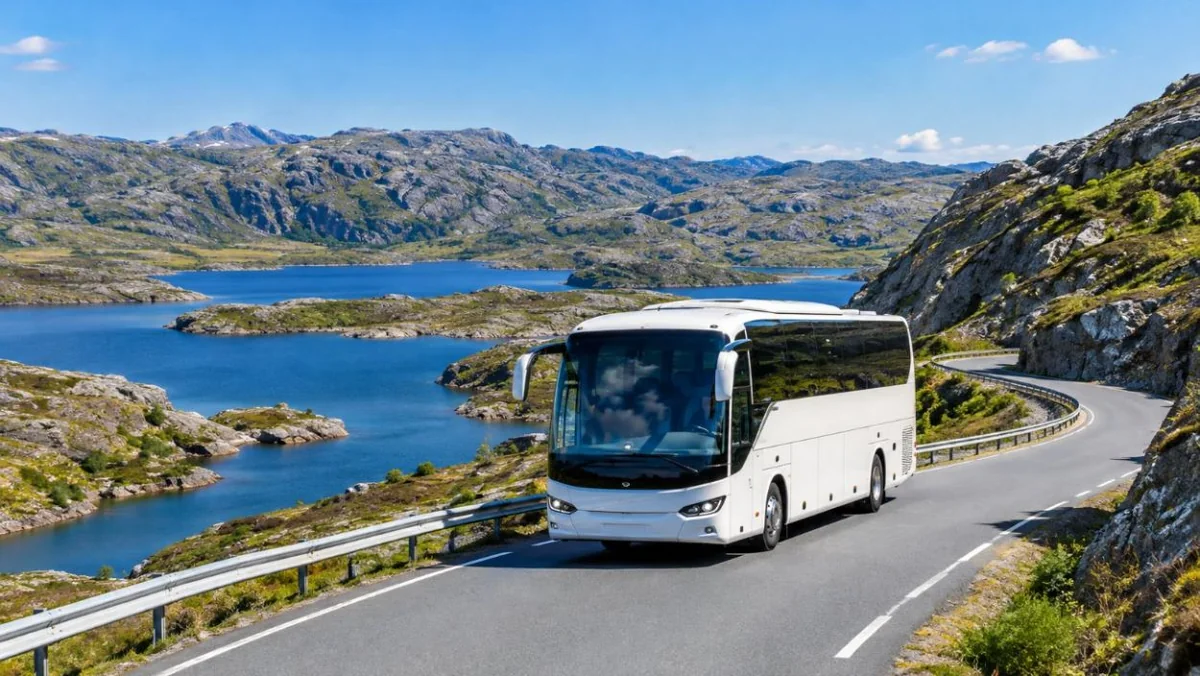
| Kjerag Express bus | About 6 hours between arrival and the 16:30 departure |
The bus window is the tight one. If you're on the Kjerag Express, you need a steady pace, a short lunch and a rough turnaround time. Miss the bus and you're stuck on a mountain road with no other public transport.
Do you need climbing experience for the chains?
No. The chains are handrails on steep slabs, not a climbing route. You hold on and walk your feet up; no harness or rope is involved.
Going up is mostly a leg workout with some pulling. Coming down is the test: you face the slab or go sideways, keep the chain in one hand and place each foot on the textured rock rather than in the polished groove where everyone else has slipped. Fjord Norway warns that descending the chains can be frightening and suggests extra time if you're afraid of heights.
Bring a pair of thin gloves. Cold chain and wet hands are a bad combination, and gloves save your palms on the long slabs. The chains are taken down when the road closes for winter and put back after it reopens, so off-season hikers have nothing to hold.
How fit do you need to be?
Fit enough to climb steadily for an hour on steep ground, rest briefly and do it again twice, then reverse it all on tired legs.
Here's a test that works. Find a hill, a stairwell or a stair machine and climb 400 to 500 metres of height in one session without long stops. If that leaves you sore but able to walk down normally, you'll manage Kjerag at a steady pace. If it wrecks you, train for a few weeks or pick Preikestolen this trip.
Age matters less than habit. The private hike has taken hikers in their seventies, and the guided day turns away people with low fitness, vertigo or a fear of heights. Knees are the usual complaint: the descents are long and steep, and poles help on the dirt sections even if you stow them on the chains.
A guide sets a pace you can hold, reads the weather and knows where the water is. Bring lunch and good boots; the rest is organised.
Explore the guided Kjerag day Tour detailsWhat should you wear? Can you wear jeans?
No jeans and no trainers: Visit Norway says so in as many words. Wear hiking boots with ankle support, quick-drying trousers and a wind- and waterproof shell.
Jeans get heavy and cold when wet and rub on long climbs. Trainers lose grip on wet granite, and the chains put your full weight on your feet. Visit Norway's Kjerag safety page lists what to wear:
- Hiking boots with a stiff, grippy sole. Trail runners with a good lug sole work for experienced hikers in dry weather.
- Layers: a base layer, a warm mid layer and a wind- and waterproof jacket. It can be 20 degrees in the car park and windy and cold on the plateau.
- Spare clothes, a cap, a scarf or buff and gloves, even in July.
- Rain trousers if showers are forecast.
The private tour lends full hiking gear free if you ask in advance, which helps if you've flown in with cabin baggage only.
What should you bring, and where is the water?
A 30-litre pack with food for the day, at least a litre of water, a headlamp, a charged phone and a first-aid kit. Refill at the stream in Storedalen.
Visit Norway's list is the standard one for Norwegian mountains: a 30-litre backpack, map and compass, first-aid kit, a fully charged phone and a headlamp. Add sunscreen; the granite reflects. There are no toilets on the trail, so use the service building at Øygardstøl before you start, and carry all rubbish back down. Drones are not permitted in the area.
Water: carry what you need for the first two climbs, then refill in Storedalen on the way up and again on the way back. The guided day stops at a mountain stream for the same reason. Food: bring lunch even on a tour. The guided listing mentions meals and drinks in its inclusions but tells you to bring snacks and water, and the private tour includes only a Norwegian snack at the top.
Flying light? The private hike lends hiking gear on request and brings crampons when the trail needs them.
Check dates for the private Kjerag hikeWhen should you turn back?
When the weather turns, when daylight gets short, or when you're behind schedule at the top of the third climb. Set a turnaround time before you leave the car.
Fjord Norway's rule is not to start if you might not be back before dark. Ours is stricter and easier to use: if you aren't on top of the third climb about three and a half hours after leaving the car park, go back. The return takes almost as long as the way up, and it's the half where tired people slip.
- Fog on the plateau: turn around. Following the red T in fog is slow and easy to lose.
- Rain on the chains: slow down and decide at each slab. Turning back is no failure.
- Snow on the route: without a guide, don't go on. Fjord Norway says to use a guide whenever there is snow.
- Someone in the group is struggling: the whole group turns.
For the safety side of the boulder itself, read is Kjeragbolten safe.
Frequently asked questions
Is Kjerag harder than Preikestolen?
Yes, clearly. Preikestolen is about 8 km with around 500 metres of ascent on a built path. Kjerag is about 11 km with 750 to 800 metres of ascent over three steep climbs with chains.
Can beginners hike Kjerag?
Fit beginners can, especially with a guide. Hiking experience matters less than fitness and comfort on steep rock. If you have never walked uphill for a couple of hours, train first or start with Preikestolen.
Can children hike to Kjeragbolten?
Fit, confident older children manage it with an adult close by on the chains. The private tour on this site takes children from age 10. Small children who need carrying should not attempt it.
Do I need hiking poles for Kjerag?
They are optional. Poles help on the knees going down the dirt sections, but you'll need both hands on the chains, so choose folding poles that stow on your pack.
Ready to book
Choose your way up
Free cancellation up to 24 hours before on every option. Check live availability for your date on each listing.
Kjerag Hike with Guide and Transport
- Guide on the trail, max 8 hikers
- Van pickup in Stavanger or Sandnes and back
- Safety briefing before the first climb
Private Kjeragbolten Hike with a Local Guide
- Private guide who also drives
- Pickup and drop-off at your Stavanger accommodation
- Parking and entry fees